Travel Virtual Assistant: What to Hand Off, What to Keep, and How to Hire One (2026)
In this article
You travel. Your inbox does not stop.
A travel virtual assistant takes the research, booking logistics and disruption watching off you, so a trip costs you a few decisions instead of a few evenings. This guide shows what to hand off, what to keep, and how to brief one. It is a buyer’s guide, not a supplier list, and VirtualCrew does not place or sell VAs.
Before You Hire a Travel Virtual Assistant
Most travel-VA hires go wrong before the first booking, because the owner never decided what the VA may spend, change or cancel. Settle five points first: scope, spending limit, payment method, hours of overlap and one named person who approves.
Work through this checklist before you post a job or message a candidate:
- You can name your trip tasks. Write down the last three trips and every task they created: searching fares, comparing hotels, seat selection, ground transport, expense receipts. If you cannot list them, you cannot delegate them.
- You have a spending rule. Decide the amount your VA can commit without asking, and the amount that needs your yes. The matrix further down gives a starting layout.
- You have a payment plan that never shares your own card. Use a virtual or company card with a limit, or pay yourself after approving each booking. Never email card numbers.
- You know your overlap hours. A VA in Manila is 13 hours ahead of New York in winter and 12 hours ahead in summer. Decide which hours you need live replies.
- You know your trip rhythm. Two trips a year need a different hire than two trips a month. Bursty work suits hourly or project hiring. Steady work suits a part-time retainer.
If two of these are unclear, fix them first. A vague brief attracts vague candidates and ends in a refund argument.
What Does a Travel Virtual Assistant Do?
A travel virtual assistant is a remote contractor who handles the planning side of your trips: researching options, preparing itineraries, drafting booking requests, tracking confirmations and watching for schedule changes. The role is administrative. You approve the money and the risk; they do the legwork.
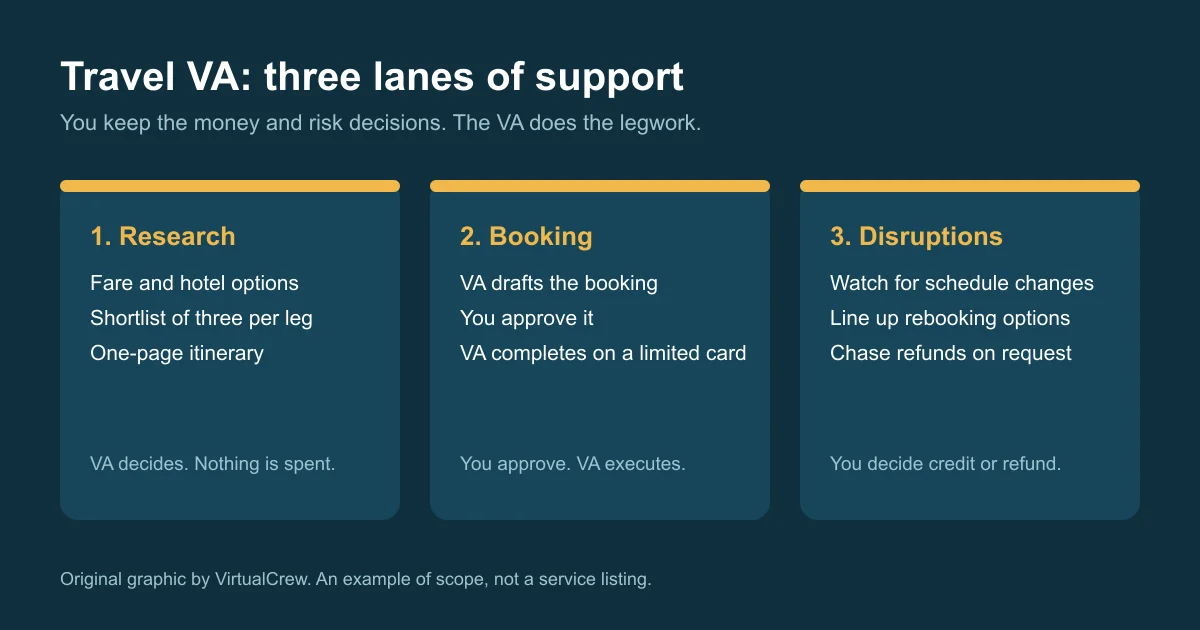
Most travel VAs work in three lanes, and the lanes matter more than any job title.
Lane 1: research and itinerary prep. Fare and hotel comparisons, a shortlist of three options per leg, an itinerary document with confirmation numbers, addresses and phone numbers in one place. This is the safest lane to hand off first, because nothing is spent.
Lane 2: booking with your approval. The VA drafts the booking, you approve it, then the VA completes it on the card you provide. Add seat selection, loyalty numbers, ground transport and restaurant reservations.
Lane 3: disruption watching. Checking for schedule changes, re-checking connection times, chasing a refund or a rebooking, and updating your calendar. This lane is where an assistant earns the fee, because disruption usually lands at a bad hour.
What a travel VA is not: a licensed travel agent, a concierge with supplier discounts, or a visa lawyer. If a candidate claims any of those, ask for the proof. Our executive VA guide covers travel inside a wider calendar-and-inbox role. This page covers the case where travel is the job.
Who Should Approve Bookings, Changes and Refunds?
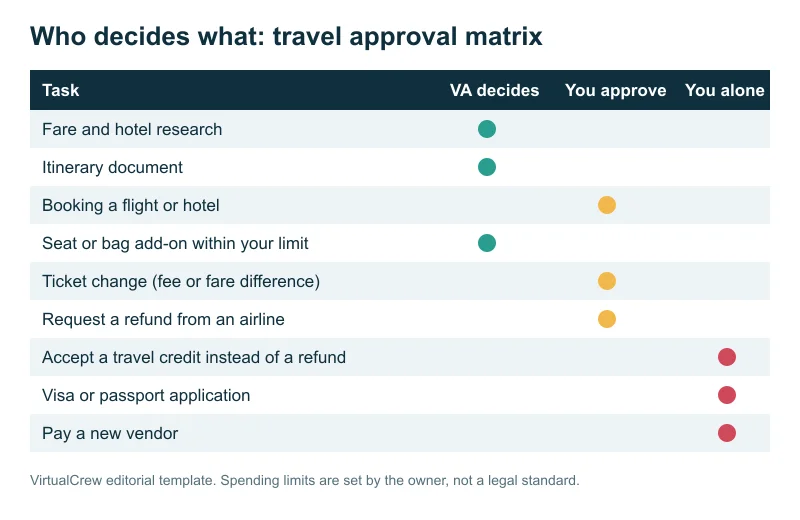
Give the VA full authority over research and itinerary documents, draft authority over bookings, and no authority over refunds, payments to new vendors or visa filings. One owner decision per spend keeps mistakes small and reversible.
An approval matrix removes the daily “can I book this?” message. Here is a layout to adapt, using a spending limit that you choose:
| Task | VA decides | VA drafts, you approve | You decide alone |
|---|---|---|---|
| Fare and hotel research | Yes | ||
| Itinerary document and calendar entries | Yes | ||
| Booking a flight or hotel | Yes | ||
| Seat selection and bag add-ons within your limit | Yes | ||
| Changing a ticket (fee or fare difference) | Yes | ||
| Accepting a travel credit instead of a refund | Yes | ||
| Requesting a refund from an airline | Yes | ||
| Visa or passport applications | Yes | ||
| Paying a new vendor | Yes |
Source: VirtualCrew editorial template. The limits are yours to set; the table shows who holds each decision, not a legal standard.
The refund and credit rows are not arbitrary. U.S. Department of Transportation rules require an airline that offers a credit instead of a refund to state your right to a full refund, and the credit must stay valid for at least five years (14 CFR 260.6). Accepting a credit gives up that cash refund, so the decision stays with you.
Which Booking and Refund Rules Should Your VA Know?
Your VA should know three rules for U.S. flights: a cancelled flight can mean a refund, a 24-hour cancellation window exists on tickets bought a week or more out, and the merchant of record is responsible for the refund. Knowing the rules turns a disruption into a checklist.
Do not expect your VA to be a lawyer. Expect them to know where to look. Hand them these points, which come from the U.S. Department of Transportation’s refund rules and its consumer page on refunds, and ask them to confirm each one against the current text before acting.
For flights to, from or within the U.S., a consumer who holds a nonrefundable ticket gets a full refund when the airline cancels a flight or significantly delays or changes it, and the consumer chooses not to fly the new flight or accept a credit (14 CFR 260.6). The rules define “significant” as a departure or arrival three hours or more away from plan on a domestic itinerary, or six hours or more on an international one (14 CFR 260.2).
A “prompt” refund means within 7 business days for credit card purchases and within 20 calendar days for cash, check, debit card or other payments (14 CFR 260.2). The DOT’s consumer page adds that, on tickets bought directly from an airline, the refund is automatic and you should watch email, texts and app alerts for schedule changes.
The same DOT consumer page says airlines must let you cancel within 24 hours of booking for tickets bought at least seven days before departure, or hold the fare for 24 hours without payment. The airline can choose which option it offers.
One more rule saves arguments. The “merchant of record” is the carrier or ticket agent shown on your card statement, and it is responsible for processing the refund (14 CFR 260.2). If you bought through an online agency, find out who that is before you chase the wrong company. The DOT page adds that seat and bag fees still go to the airline.
These rules cover U.S. air travel. Rail, hotels, rental cars and flights outside the U.S. follow other terms, so your brief should say which trips your VA should research case by case.
How Much Does a Travel Virtual Assistant Cost?
A travel virtual assistant is priced like any other VA: by the hour or by a monthly retainer, set by region and experience. Our rates guide lists general admin VAs in the Philippines at $5 to $10 an hour and executive-level support at $15 to $30. Travel work usually bills at the same band.
There is no separate travel price list, and be careful with anyone who invents one. These are the bands from VirtualCrew’s VA rates guide, on a direct-hire basis:
| Support level | Philippines ($/hr) | US / UK ($/hr) |
|---|---|---|
| General admin (research, itinerary documents) | $5 to $10 | $25 to $40 |
| Executive assistant (booking judgment, disruption handling) | $15 to $30 | $45 to $85 |
Source: VirtualCrew, VA rates guide. Direct-hire rates, before platform fees or agency markup.
Now the arithmetic for one trip. This is an illustration, not a quote. Suppose a three-leg trip takes six hours of research, booking and itinerary prep. At $10 an hour, that is $60. At $25 an hour, it is $150. Add a short disruption-watching window, and you still pay for hours, not for a travel package.
Compare that with your own time. If a trip steals two evenings, price those evenings. The cost question is rarely the VA’s rate. It is whether you set the brief up so the hours produce a finished itinerary and not a draft that bounces back to you.
For the full cost picture, including platform fees and the first-month ramp, read how much it costs to hire a virtual assistant.
Does this sound like your trip calendar? Find out how many hours you lose to tasks a VA could take. Take the Delegation Audit. About five minutes. Free. No pitch.
How Do You Hand Over a Trip When You Are 12 Hours Apart?
A time-zone gap works in your favor if the handover is written. Manila is 13 hours ahead of New York in winter and 12 hours ahead in summer, so a brief sent at the end of your day can come back finished before breakfast.
The Philippines does not use daylight saving time, so the gap shifts by one hour when the U.S. clocks change. Your 9 a.m. in New York is 10 p.m. in Manila in winter, and 9 p.m. in summer. The shift is a classic source of a missed call two weeks after a clock change.
A workable rhythm looks like this:
- End of your day: send or update the trip brief and list of decisions you need from the VA.
- Their working day: research and drafts arrive in your shared document.
- Start of your day: you approve, choose or reject in a ten-minute block.
- Rule for emergencies: define one channel and one phrase, such as “URGENT: flight change”, that the VA may use any hour.
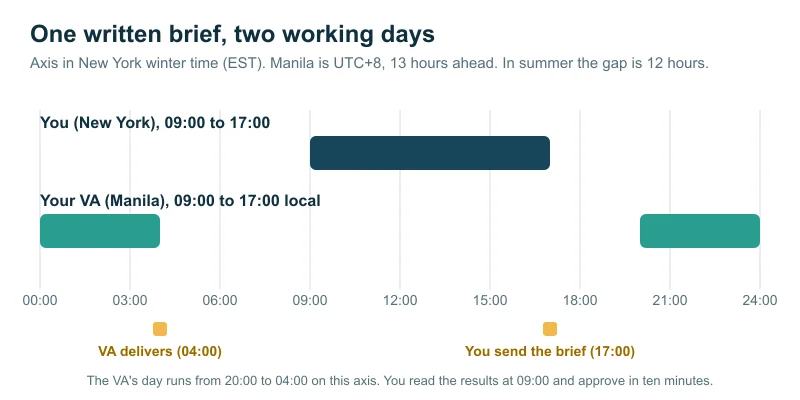
Agree on a daily “last check” time during any trip you are on. The costly disruption is the one that lands at 2 a.m. in your time zone. A VA in Asia is awake then, so a written plan for that hour does real work.
What Should a Trip Brief Include?
A good trip brief has seven parts: dates and cities, hard constraints, preferences, budget and approval limits, the traveler’s documents status, contacts, and a “what to do if” list. One page is enough, and it saves more time than any tool.
Here is a sample you can copy. The trip is invented, so replace every detail.
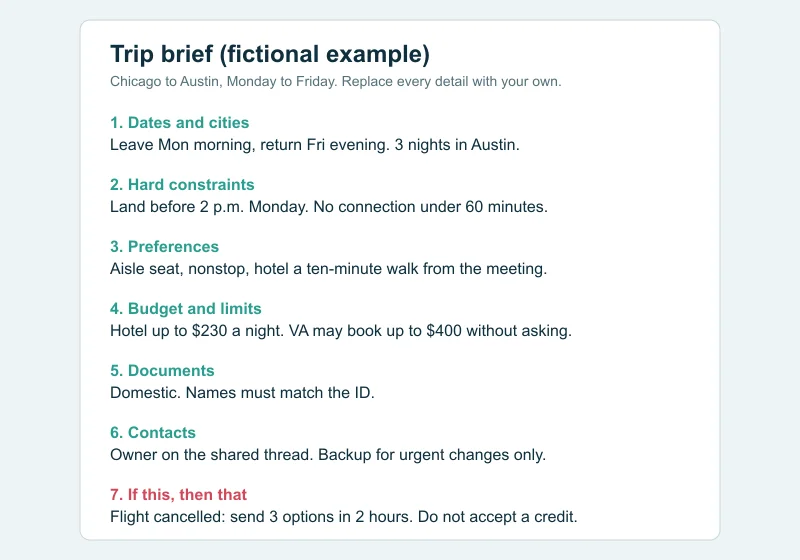
Sample trip brief (fictional example)
- Dates and cities: Leave Chicago on a Monday morning, return Friday evening. Three nights in Austin.
- Hard constraints: Land before 2 p.m. on Monday for a 4 p.m. meeting. No itinerary with a connection shorter than 60 minutes.
- Preferences: Aisle seat, nonstop where possible, hotel within a ten-minute walk of the meeting.
- Budget and limits: Hotel up to $230 a night. The VA may book up to $400 without asking. Above that, send three options and wait.
- Documents: Passport not needed (domestic). Check the ID rules on the airline’s page and confirm names match the ID.
- Contacts: Owner on the shared chat thread. Backup: the owner’s business partner, only for urgent changes.
- If this, then that: If the flight is cancelled, find three alternatives within two hours of the original time and message the owner. Do not accept a credit.
Two details make this brief work. The spending limit sits inside the brief, so the VA does not have to ask. And “do not accept a credit” ties back to the refund rules above.
For international trips, add passport validity and visa lines. The U.S. State Department says routine passport processing takes 4 to 6 weeks and expedited service takes 2 to 3 weeks, with mailing time that may add up to 2 weeks on top, according to the “Get It Fast” page on travel.state.gov. A good travel VA puts that on your calendar before you book a flight, not after.
How Do You Choose and Test a Travel Virtual Assistant?
Test a travel VA with one paid, bounded trip task before you commit. Pick a real upcoming trip, give them the brief, and judge three things: whether the shortlist fits your constraints, whether they flag what they could not check, and how fast they answer.
Skip the portfolio request. Travel work is private, and few VAs can show client trips. Use a trial task instead:
- Give a real task, with a small scope. For example, “find three flight options for these dates, with fare, duration and connection time, in a table.”
- Pay for the trial. Unpaid tests attract people who are not serious, and they filter out people who are.
- Score it. Did they respect the hard constraints? Did they say “I could not confirm the baggage rule” when they could not? Honesty about gaps matters more than speed.
- Check how they handle a conflict. Give them an impossible constraint on purpose and watch whether they say so.
Where to find candidates is a separate question. Direct-hire boards, marketplaces and agencies each fit a different owner, and how to hire a virtual assistant walks through the routes. After the hire, a written delegation routine stops the work from drifting back to you.
What Are the Most Common Mistakes When Hiring a Travel VA?
The costliest mistakes are not about skill. They are unclear spending authority, shared personal cards and no written plan for disruptions. Each one is cheap to fix before the first booking and expensive to fix after the first problem.
1. Sharing your own card. Use a virtual card, a company card or a pay-after-approval process. A card with a limit turns a bad booking into a small problem.
2. Skipping the spending rule. A VA without a limit either asks you about everything or guesses. Both cost you. Put the limit in writing.
3. Treating a travel credit as a refund. Airlines may offer a credit in place of money. Accepting it is your decision, not your VA’s. The DOT rules say the credit must stay valid for at least five years and that the airline must tell you about your refund right (14 CFR 260.6).
4. Hiring by price alone. The cheapest hour looks good until a missed connection costs a full day. Match the level to the task, using the rates bands above.
5. No disruption plan. If your flight is cancelled at 1 a.m., your VA needs to know whom to message and what they may rebook. The “if this, then that” list in your brief solves this.
Frequently Asked Questions
What does a travel virtual assistant do?
A travel virtual assistant researches fares and hotels, prepares itineraries, drafts bookings for your approval, tracks confirmations and watches for schedule changes. Most work is administrative. You keep the spending, refund and visa decisions, and the VA handles the legwork across three lanes.
How much does a travel virtual assistant cost?
There is no separate travel rate. Direct-hire Philippine VAs run about $5 to $10 an hour for general admin and $15 to $30 for executive-level support, per VirtualCrew’s rates guide. A six-hour trip task at $10 an hour comes to $60, before platform fees.
Can a travel virtual assistant book flights for me?
Yes, with controls. Have the VA draft the booking, approve it yourself, then let them complete it on a limited virtual or company card. Keep refund requests, travel credits and visa filings under your own approval until you have a track record.
Is a travel VA the same as a travel agent?
No. A travel agent is a business that sells and books travel and may be the merchant of record for refunds. A travel VA is a remote assistant who works for you. Ask any VA who claims licensed-agent status for proof of it.
How do I find a travel virtual assistant?
Use a direct-hire board, a freelance marketplace or an agency, then run a paid trial task on a real trip. VirtualCrew is a guide, not a marketplace or placement service, so use the hiring guide to compare routes before you choose.
Keep Reading
What to Do Next
Choose the path that fits where you are right now.
Audit Your Delegation
Take the Delegation Audit and find out how many hours you could reclaim with a VA.
Take the Audit